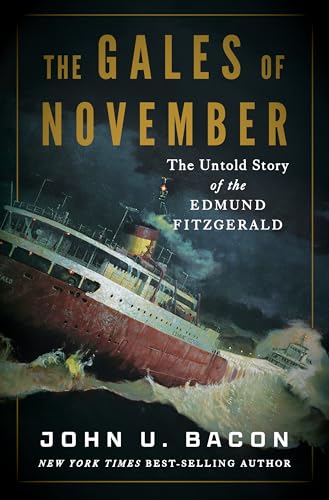
The Gales of November: The Untold Story of The Edmund Fitzgerald by John U. Bacon
Blurb:
For three decades following World War II, the Great Lakes overtook Europe as the epicenter of global economic strength. The region was the beating heart of the world economy, possessing all the power and prestige Silicon Valley does today. And no ship represented the apex of the American Century better than the 729-foot-long Edmund Fitzgerald—the biggest, best, and most profitable ship on the Lakes.
But on November 10, 1975, as the “storm of the century” threw 100 mile-per-hour winds and 50-foot waves on Lake Superior, the Mighty Fitz found itself at the worst possible place, at the worst possible time. When she sank, she took all 29 men onboard down with her, leaving the tragedy shrouded in mystery for a half century.
In The Gales of November, award-winning journalist John U. Bacon presents the definitive account of the disaster, drawing on more than 100 interviews with the families, friends, and former crewmates of those lost. Bacon explores the vital role Great Lakes shipping played in America’s economic boom, the uncommon lives the sailors led, the sinking’s most likely causes, and the heartbreaking aftermath for those left behind—"the wives, the sons, and the daughters,” as Gordon Lightfoot sang in his unforgettable ballad.
Focused on those directly affected by the tragedy, The Gales of November is both an emotional tribute to the lives lost and a propulsive, page-turning narrative history of America’s most-mourned maritime disaster.
I really enjoyed understanding the economics of Great Lakes shipping, the science of why November is the worst month on the Lakes (not say, January), and the detailed descriptions of what happened on November 9-10, 1975 on Lake Superior (funny how the other 4 lakes retain a form of their Indigenous names; I suppose English speakers didn't want to call it any variation of Gumee or Gami). The author spoke to many, many people with first-hand knowledge of the Fitz, including former crew members, family members of the lost crew, and various people on both ends of the journey who interacted with the Fitz and her crew.
It's amazing that the ultimate cause of the sinking remains a mystery. Weather, obviously, and lack of reliable data about the weather. But also, capitalism, I would say. There were three captains that sailed that day. One of them decided to hell with his bosses and parked his ship in Thunder Bay, even though he knew he would lose his 'on-time' bonus. The second captain and his ship, the Arthur Anderson, survived through pure luck. The third captain, Captain McSorley of the Edmund Fitzgerald, made every possible wrong decision he could have made due to not having the proper data about the storm and topography of Lake Superior.
There was a great deal of information about Gordon Lightfoot and how he came to write the song that has kept "The Wreck of the Edmund Fitzgerald" in the public consciousness. According to reports, he became very close with the families of the crew.
The one criticism I would have about this book is that it is a little bit disorganized, with a lot of hopping back and forth in time. For instance, Lightfoot is brought up well before the chapters dealing with the sinking, with no indication that he was even aware of the Fitz before she sank. Other than that, I highly recommend it.
And as a footnote, now I know the difference between two 1970s ballads with very similar names: "Brandy" and "Mandy". The lyrics to "Brandy" are printed at the end of the book.
![[personal profile]](https://www.dreamwidth.org/img/silk/identity/user.png) siria
siria

![[community profile]](https://www.dreamwidth.org/img/silk/identity/community.png)





![[syndicated profile]](https://www.dreamwidth.org/img/silk/identity/feed.png)