
![[personal profile]](https://www.dreamwidth.org/img/silk/identity/user.png)


Entry tags:
Merry Christmas
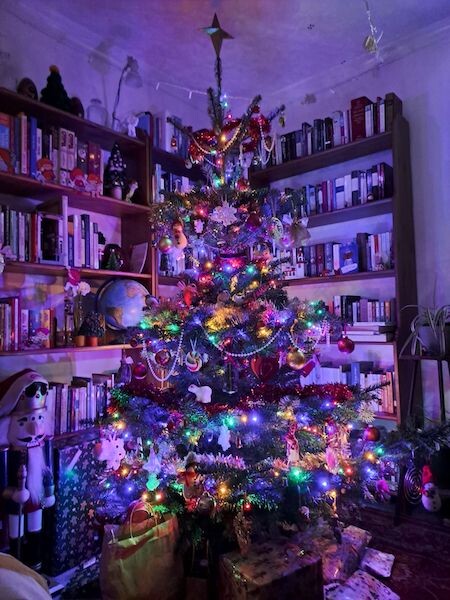
ETA: Meant to add this bit from A Christmas Carol. It's from the Ghost of Christmas Present, and one of the parts that's never really included in any adaptation, but I love it.
For, the people who were shovelling away on the housetops were jovial and full of glee; calling out to one another from the parapets, and now and then exchanging a facetious snowball—better-natured missile far than many a wordy jest—laughing heartily if it went right and not less heartily if it went wrong. The poulterers’ shops were still half open, and the fruiterers’ were radiant in their glory. There were great, round, pot-bellied baskets of chestnuts, shaped like the waistcoats of jolly old gentlemen, lolling at the doors, and tumbling out into the street in their apoplectic opulence. There were ruddy, brown-faced, broad-girthed Spanish Onions, shining in the fatness of their growth like Spanish Friars, and winking from their shelves in wanton slyness at the girls as they went by, and glanced demurely at the hung-up mistletoe. There were pears and apples, clustered high in blooming pyramids; there were bunches of grapes, made, in the shopkeepers’ benevolence to dangle from conspicuous hooks, that people’s mouths might water gratis as they passed; there were piles of filberts, mossy and brown, recalling, in their fragrance, ancient walks among the woods, and pleasant shufflings ankle deep through withered leaves; there were Norfolk Biffins, squat and swarthy, setting off the yellow of the oranges and lemons, and, in the great compactness of their juicy persons, urgently entreating and beseeching to be carried home in paper bags and eaten after dinner. The very gold and silver fish, set forth among these choice fruits in a bowl, though members of a dull and stagnant-blooded race, appeared to know that there was something going on; and, to a fish, went gasping round and round their little world in slow and passionless excitement.
The Grocers’! oh, the Grocers’! nearly closed, with perhaps two shutters down, or one; but through those gaps such glimpses! It was not alone that the scales descending on the counter made a merry sound, or that the twine and roller parted company so briskly, or that the canisters were rattled up and down like juggling tricks, or even that the blended scents of tea and coffee were so grateful to the nose, or even that the raisins were so plentiful and rare, the almonds so extremely white, the sticks of cinnamon so long and straight, the other spices so delicious, the candied fruits so caked and spotted with molten sugar as to make the coldest lookers-on feel faint and subsequently bilious. Nor was it that the figs were moist and pulpy, or that the French plums blushed in modest tartness from their highly-decorated boxes, or that everything was good to eat and in its Christmas dress; but the customers were all so hurried and so eager in the hopeful promise of the day, that they tumbled up against each other at the door, crashing their wicker baskets wildly, and left their purchases upon the counter, and came running back to fetch them, and committed hundreds of the like mistakes, in the best humour possible; while the Grocer and his people were so frank and fresh that the polished hearts with which they fastened their aprons behind might have been their own, worn outside for general inspection, and for Christmas daws to peck at if they chose.
But soon the steeples called good people all, to church and chapel, and away they came, flocking through the streets in their best clothes, and with their gayest faces. And at the same time there emerged from scores of bye-streets, lanes, and nameless turnings, innumerable people, carrying their dinners to the bakers’ shops. The sight of these poor revellers appeared to interest the Spirit very much, for he stood with Scrooge beside him in a baker’s doorway, and taking off the covers as their bearers passed, sprinkled incense on their dinners from his torch. And it was a very uncommon kind of torch, for once or twice when there were angry words between some dinner-carriers who had jostled each other, he shed a few drops of water on them from it, and their good humour was restored directly. For they said, it was a shame to quarrel upon Christmas Day. And so it was! God love it, so it was!
[...]
And now, without a word of warning from the Ghost, they stood upon a bleak and desert moor, where monstrous masses of rude stone were cast about, as though it were the burial-place of giants; and water spread itself wheresoever it listed, or would have done so, but for the frost that held it prisoner; and nothing grew but moss and furze, and coarse rank grass. Down in the west the setting sun had left a streak of fiery red, which glared upon the desolation for an instant, like a sullen eye, and frowning lower, lower, lower yet, was lost in the thick gloom of darkest night.
“What place is this?” asked Scrooge.
“A place where Miners live, who labour in the bowels of the earth,” returned the Spirit. “But they know me. See!”
A light shone from the window of a hut, and swiftly they advanced towards it. Passing through the wall of mud and stone, they found a cheerful company assembled round a glowing fire. An old, old man and woman, with their children and their children’s children, and another generation beyond that, all decked out gaily in their holiday attire. The old man, in a voice that seldom rose above the howling of the wind upon the barren waste, was singing them a Christmas song—it had been a very old song when he was a boy—and from time to time they all joined in the chorus. So surely as they raised their voices, the old man got quite blithe and loud; and so surely as they stopped, his vigour sank again.
The Spirit did not tarry here, but bade Scrooge hold his robe, and passing on above the moor, sped—whither? Not to sea? To sea. To Scrooge’s horror, looking back, he saw the last of the land, a frightful range of rocks, behind them; and his ears were deafened by the thundering of water, as it rolled and roared, and raged among the dreadful caverns it had worn, and fiercely tried to undermine the earth.
Built upon a dismal reef of sunken rocks, some league or so from shore, on which the waters chafed and dashed, the wild year through, there stood a solitary lighthouse. Great heaps of sea-weed clung to its base, and storm-birds—born of the wind one might suppose, as sea-weed of the water—rose and fell about it, like the waves they skimmed.
But even here, two men who watched the light had made a fire, that through the loophole in the thick stone wall shed out a ray of brightness on the awful sea. Joining their horny hands over the rough table at which they sat, they wished each other Merry Christmas in their can of grog; and one of them: the elder, too, with his face all damaged and scarred with hard weather, as the figure-head of an old ship might be: struck up a sturdy song that was like a Gale in itself.
Again the Ghost sped on, above the black and heaving sea—on, on—until, being far away, as he told Scrooge, from any shore, they lighted on a ship. They stood beside the helmsman at the wheel, the look-out in the bow, the officers who had the watch; dark, ghostly figures in their several stations; but every man among them hummed a Christmas tune, or had a Christmas thought, or spoke below his breath to his companion of some bygone Christmas Day, with homeward hopes belonging to it. And every man on board, waking or sleeping, good or bad, had had a kinder word for another on that day than on any day in the year; and had shared to some extent in its festivities; and had remembered those he cared for at a distance, and had known that they delighted to remember him.
no subject
no subject
no subject
Lovely!
no subject
no subject
no subject